Short answer
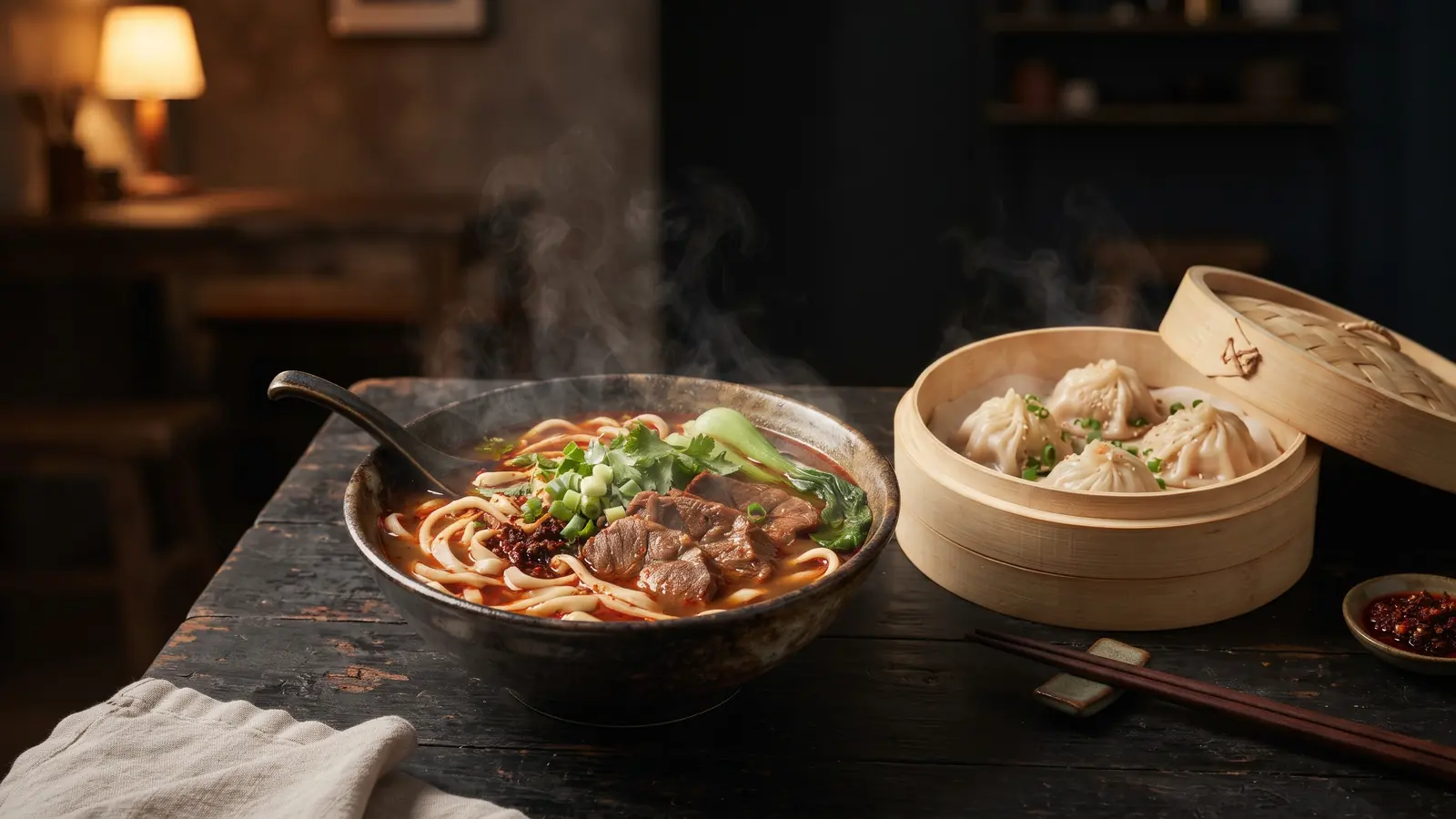
Knife cut noodles are wheat noodles made by cutting or shaving strips from a block of dough with a blade instead of stretching it. They have uneven edges, a thick chewy bite and hold sauce well, which is why they suit hearty stews and stir-fries.
Knife cut noodles are wheat noodles that are cut or shaved from a block of dough with a blade rather than stretched by hand. They come out flat and slightly uneven, with a thick, chewy bite that holds sauce, and they are common across northern China.
What are knife cut noodles?
Knife cut noodles are fresh wheat noodles made from a stiff dough of flour, water and salt that is sliced into strips by knife or shaved off in thin ribbons. The result is a noodle with a broad flat shape and ragged edges.
The best-known form is dao xiao mian (knife-shaved noodles), linked with Shanxi province. A cook holds a rested block of dough in one hand and shaves long thin strips with a curved blade straight into a pot of boiling water. Other regions cut the noodles from a rolled sheet, which is closer to how Italian cooks cut tagliatelle.
The noodles are also written as knife-cut noodles, dao qie mian, or simply “sliced noodles” on English menus. They are a staple in the wheat-growing north and north-west of China, where noodles are an everyday food.
How are knife cut noodles made?
Cooks make a stiff dough, rest it until the gluten relaxes, then cut or shave it into strips and boil them straight away. The dough is firmer than bread dough, which keeps the strips from sticking.
- Mix about 2 cups (250 g) flour with 1/2 cup (120 ml) water and a pinch of salt.
- Knead for ten minutes until the dough is smooth and firm.
- Cover and rest for 30 to 60 minutes.
- Roll the dough into a thick sheet or keep it as a block.
- Slice strips with a sharp knife or shave them off with a curved blade.
- Boil for two to four minutes and drain.
A home cook can dust the rolled sheet with flour, fold it over three times and cut across the folds. When the strips are shaken out, they unfold into long noodles.
Knife cut vs hand-pulled noodles: what is the difference?
Knife cut noodles are cut from the dough, while hand-pulled noodles are stretched from it. The cutting method gives flat strips with uneven edges and a dense chew, while pulling makes smoother, springier strands.
| Feature | Knife cut noodles | Hand-pulled noodles |
|---|---|---|
| How made | Sliced or shaved with a blade | Stretched and folded by hand |
| Shape | Flat, with rough edges | Round, ribbon or very wide |
| Texture | Dense, chewy, substantial | Springy, elastic, smooth |
| Dough | Firm, lower hydration | Softer, rested and oiled |
| Typical use | Stews, stir-fries, thick sauces | Soups and light sauces |
| Skill needed | Knife control | Pulling technique |
Both are fresh wheat noodles from the same region, and a good restaurant may offer one or both. The AiPaPa restaurant, described as serving Lanzhou-style food, does not list knife cut noodles on its recorded menu.
What do knife cut noodles taste like?
Knife cut noodles taste mild and wheaty, with a chewy bite that is firmer than spaghetti. Their uneven edges soak up sauce, so the flavor comes mostly from what they are served with.
The thick, ragged sections of each noodle stay chewy, while the thin edges soften. That variety is part of the appeal and is why cooks seldom try to make them perfectly regular. Because the noodle is plain, it works with savory sauces such as soy and vinegar, tomato and egg, and stewed meats.
What sauces and toppings suit knife cut noodles?
Thick, savory sauces and stews suit knife cut noodles best, because the flat surface carries more sauce than a round strand. Cumin lamb, tomato egg and chili oil are classics in northern China.
- Cumin lamb: stir-fried lamb with cumin, chili and onion.
- Tomato and egg: a soft, tangy sauce that clings to the strips.
- Braised beef: slow-cooked beef in a soy-based sauce.
- Chili oil and vinegar: a simple dressing with garlic and scallion.
- Vegetable stir-fry: cabbage, carrot and mushrooms.
How do you cook knife cut noodles at home?
Boil the noodles in plenty of rapidly boiling water for two to four minutes, then drain and toss with the sauce at once. Fresh noodles are done when they float and have no raw white center.
Use a large pot so the strips do not clump. Stir them gently at first, because freshly cut dough sticks to itself. Do not rinse the noodles for a hot dish, because the starch on the surface helps the sauce cling. For a cold dish, rinse them under cold water to stop the cooking.
Leftover noodles keep in the refrigerator for a day or two in a covered container with a little oil. Reheat them in a hot pan with sauce rather than boiling them again.
What are close relatives of knife cut noodles?
Close relatives include hand-pulled lamian, belt-like biang biang noodles, Japanese udon, Italian tagliatelle and Uyghur laghman. Each uses wheat dough, but the shape and method differ.
- Lamian: stretched, then folded into round strands.
- Biang biang noodles: very wide pulled belts from Shaanxi.
- Laghman: Central Asian stretched noodles with a meat and vegetable sauce.
- Udon: thick Japanese noodles, cut from rolled dough.
What mistakes ruin knife cut noodles?
The most common mistakes are dough that is too soft, too little resting time and cutting strips of uneven thickness. Each one is easy to fix once you know what to look for.
- Soft dough: wet dough sticks to the knife and the strips fuse in the pot. Keep the dough firm and add flour to the board.
- Skipped rest: unrested dough springs back when rolled and resists the knife. Rest at least 30 minutes.
- Crowded pot: too many noodles in too little water turn gummy. Use a large pot and a full boil.
- Wide, thick strips: very thick pieces stay raw in the middle while the edges soften. Aim for strips about a quarter inch wide and an eighth of an inch thick.
- Late saucing: noodles left to sit stick together. Sauce them straight from the pot.
A little unevenness is normal and even desirable in this style. The goal is a rustic noodle, not a machine-cut one.
How do you store knife cut noodles?
Fresh knife cut noodles keep in the refrigerator for up to two days if dusted with flour and stored in a covered container. For longer storage, freeze them in nests on a tray, then bag them, and cook straight from frozen.
Frozen noodles need an extra minute of boiling. Do not thaw them first, because the strips will stick together. Dried knife cut noodles sold in packs keep for months in a cool cupboard and are cooked according to the package.
Are knife cut noodles on the AiPaPa menu?
No. The AiPaPa Hot Burger-HALAL RESTAURANT menu recorded on 13 November 2026 does not list knife cut noodles. Its noodle dishes are Lanzhou Potato Noodles, Lanzhou Cold Skin Noodles, Lamb Soup Noodles and four chow mein dishes.
The menu changes, so check the menu page and call (626) 723-4586 if you want to ask about a particular noodle. Times are on the hours and location page. This guide is independent and takes no orders.
Common questions
What is the difference between knife cut and hand-pulled noodles?
Knife cut noodles are shaved or sliced from firm dough with a blade, so they are flat, uneven and chewy. Hand-pulled noodles are stretched by hand into round or ribbon shapes, so they are smoother and more elastic.
What is dao xiao mian?
Dao xiao mian, or knife-shaved noodles, is the Chinese name for noodles shaved in thin strips straight from a block of dough into boiling water. It is most associated with Shanxi province in northern China.
Can I make knife cut noodles without special tools?
Yes. Roll the dough out, fold it into layers with flour between them, and slice it with a sharp chef’s knife into strips about a quarter inch wide. Shake them loose and boil them right away.
How long do knife cut noodles take to cook?
Fresh knife cut noodles usually cook in two to four minutes, depending on thickness. They are done when they float and the thickest edge feels chewy but no longer raw in the center.
Are knife cut noodles the same as udon?
They are different. Udon is a Japanese noodle, usually round or square, made from wheat flour, salt and water. Knife cut noodles are a Chinese style cut in many widths, often with rougher edges.
Planning a visit? Start with AiPaPa Hot Burger Halal Restaurant: address, opening hours, menu and directions in one place.
This article is general information from an independent guide, not from AiPaPa Hot Burger-HALAL RESTAURANT itself. For the store’s current details see hours and location.